

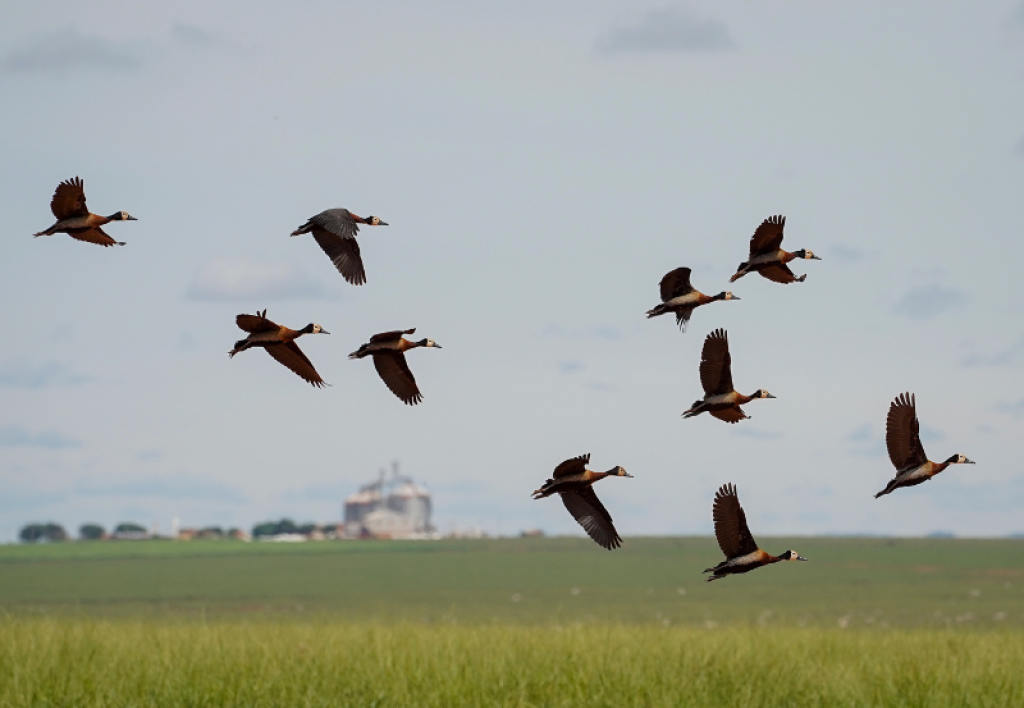
From this Monday (March 23) until 29 March, Brazil hosts the 15th Conference of the Parties to the Convention on the Conservation of Migratory Species of Wild Animals (COP15 of CMS, by its English acronym). Held in Campo Grande (MS), the meeting places at the center of the global debate the need to implement international public‑policy measures that guarantee the survival of the 1,189 species protected under the treaty.
“Migratory species do not recognize borders. For this reason, protecting them requires the best of international cooperation: shared science, joint commitments, and coordinated action,” highlights the Minister of the Ministry of the Environment and Climate Change of Brazil, Marina Silva.
According to the MMA’s executive secretary and president of COP15, João Paulo Capobianco, the country is taking on a proactive leadership role at the meeting. “Brazil is not only hosting the COP but is also putting forward proposals for the conservation of migratory species. We arrive in Campo Grande with the most robust agenda the country has ever presented in the history of this Convention, leading by example through the recent creation of Conservation Units (UCs) in the state of Rio Grande do Sul, which are crucial for protecting migratory species not only at national level but also globally,” he states.
The urgency of the meeting is reinforced by data from the report State of the World’s Migratory Species (2024), which indicates that one in every five species listed by CMS is at risk of extinction due to threats such as habitat loss and the climate emergency. For this reason, the Parties will debate at COP15 the need to include 42 new migratory species in the official list.
As a concrete safeguarding measure, the Brazilian government officially created, on 6 March, the Albardão Marine National Park (over 1 million hectares) and the Albardão Environmental Protection Area (APA) (55.9 thousand hectares), in Santa Vitória do Palmar (RS). Albardão is now the largest marine conservation unit in the country, increasing the protection of the Exclusive Economic Zone to about 26.73% and bringing Brazil closer to the global target of protecting 30% of marine environments by 2030 (Kunming‑Montreal Framework).
Migratory species in focus
Of the total number of species currently protected by the Convention, 962 are birds and the remainder are distributed among terrestrial mammals (94), aquatic mammals (64), fish (58), reptiles (10), and one insect. A large proportion of these wild animals moves through Brazilian territory. Their movement requires integrated conservation measures among neighbouring countries in order to strengthen ecological corridors capable of connecting biomes and following the natural transit of the species.
Under CMS, a species is considered migratory when its population, or part of it, crosses international borders during the life cycle, in search of food, water, safe places to reproduce, and more suitable temperatures, among other reasons. These movements depend on the maintenance of ecological corridors and on connectivity between habitats, which are one of the structural axes of debate at COP15.
Animals are protected through two main mechanisms: Appendix I, which lists species threatened with extinction that require strict protection from countries, and Appendix II, which covers species in an unfavourable conservation status that would benefit from international agreements and joint actions for their management. In Brazil, this protection is operationalised through National Action Plans (PANs), coordinated by the Chico Mendes Institute for Biodiversity Conservation (ICMBio).
Humpback whale (Megaptera novaeangliae)
With an estimated population of 34,500 individuals along the Brazilian coast, the species is protected by the Marine Cetaceans PAN. It performs annual migrations from feeding areas in the Antarctic to tropical Brazilian waters, such as the Abrolhos Bank, for reproduction and calf‑rearing. Under CMS, it is included in Appendix I.
Jaguar (Panthera onca)
A symbol of terrestrial biodiversity, although it does not undertake long‑distance seasonal migrations like birds, it depends on connectivity between biome fragments to maintain genetic flow. It is protected by the Big Cats PAN and was included in Appendices I and II of CMS following a proposal led by Brazil, aimed at promoting international cooperation for transboundary corridors.
Green sea turtle (Chelonia mydas)
A migratory marine species that travels thousands of kilometres between feeding and nesting areas. In Brazil, beaches protected by the Marine Turtles PAN and by the TAMAR Project are fundamental for the species’ reproductive success and are listed under Appendix I of the Convention.
Sand tiger shark (Carcharias taurus)
Classified as Critically Endangered, this coastal‑water predator is included in conservation initiatives such as the Sharks PAN. Its protection requires controlling directed fishing, especially through gillnets. In 2020, a transboundary conservation agenda was also established between Brazil, Uruguay and Argentina, specifically aimed at protecting the species.
Migratory catfish
Species such as the dourada (Brachyplatystoma rousseauxii) undertake the largest freshwater migration in the world, travelling from the Amazon River estuary to its headwaters in the Andes to spawn. The pintado (Pseudoplatystoma corruscans), which occurs mainly in the São Francisco and La Plata river basins, and the piramutaba (Brachyplatystoma vaillantii), characteristic of the Amazon Basin, also depend on river systems free from dams for their survival. At COP15, Brazil proposes including pintado in Appendix II. Bolivia, Colombia, Ecuador, Peru, Venezuela and Brazil will jointly present at the Conference the creation of a Multispecies Action Plan for Amazonian Migratory Catfish.
Wandering albatross (Diomedea exulans)
A large‑bodied seabird that flies across all oceans of the Southern Hemisphere. In Brazil, it is protected by the National Action Plan for the Conservation of Albatrosses and Petrels (PLANACAP), which works to implement measures to reduce incidental bycatch by longline fishing fleets.
Rufous‑necked sandpiper (Calidris subruficollis)
A small bird that travels some 30,000 kilometres annually between the Arctic and South America. Dependent on natural wetlands such as those in southern Brazil and in the Pantanal, it suffers from habitat loss and is protected by the National Action Plan for Migratory Shorebirds. It is also part of the Memorandum of Understanding for the Conservation of Migratory Bird Species of the Southern Grasslands of South America and Their Habitats (MoU Pastizales).
About CMS and COP15
CMS is an environmental treaty of the United Nations, in force since 1979, which promotes the conservation of migratory species, their habitats and migration routes at a global scale.
The COP is CMS’s main decision‑making body, where 132 countries and the European Union meet to update the list of species protected by the agreement, the budget of the CMS Secretariat, and resolutions that guide public policies and conservation initiatives around the world. The meeting is held every three years.
CMS brings together governments, scientists, indigenous peoples, traditional communities, civil society and wildlife experts to address challenges related to the conservation of migratory fauna at a global scale.
Special Social Communication Office of MMA
[email protected]
(61) 2028‑1227/1051
Access the MMA Flickr